

 More Products
 Compare











我的荣耀 开启荣耀之旅



 Disagree Terms
 Log out




[Honor Content Crew] Honor 9X Pro Kirin 810 Da Vinci Architecture


 Last reply :
Honor 9X blows away the competition at the AI-Benchmark tests — utilizing the Da Vinci architecture to redefine what's possible
Honor's brand-new budget smartphone 9X series was launched with Kirin 810, the brand's proprietaryhigh-end SoC that incorporates the elite 7nm chip process seen on the Kirin 980 and 990, Snapdragon 855 (and rumored on the 865), and Apple's A12 and A13, but at a much more competitive price. Notably, the Kirin 810 adopts yet another in-house development in its NPU design — the so-called "Da Vinci architecture" — which provides for even more impressive AI capabilities that gets it ahead in the performance race than the most renowned names in the industry!
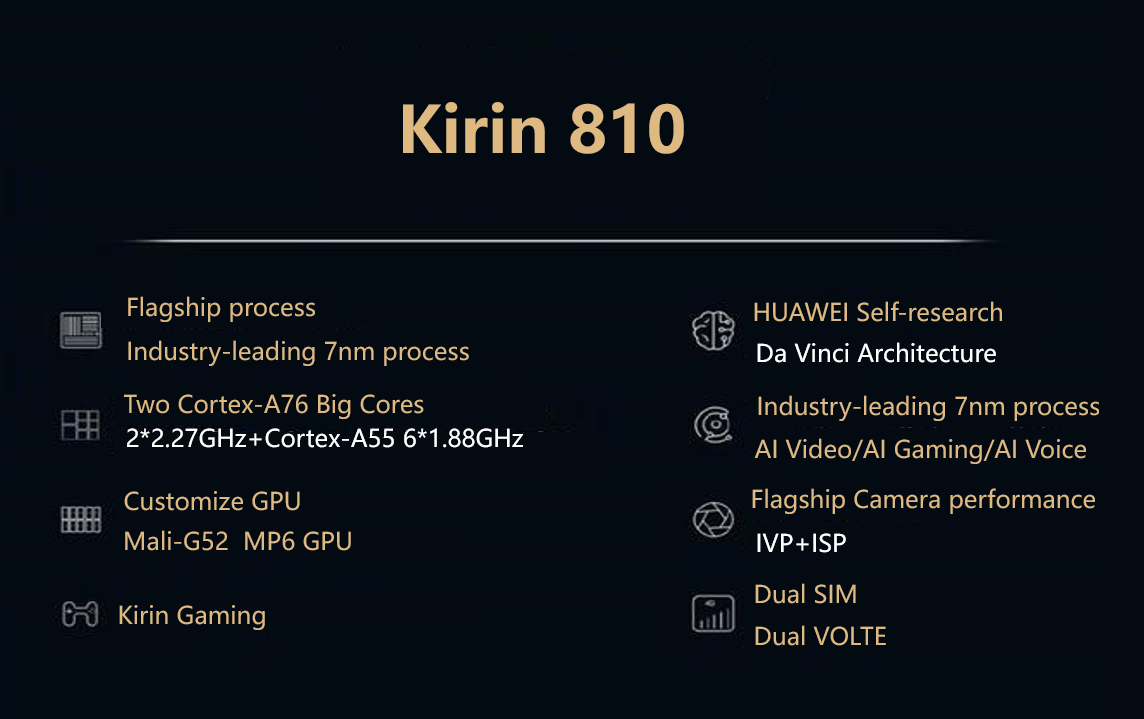
Artificial intelligence will assuredly play an important role in the future, linking people with the intelligent devices around them,as well as the devices themselves with one another. Huawei/Honor has long explored AI's applicationson terminal devices. This led to the use of an AI-supported Neural-network Processing Unit on the Kirin 970 chipset,resulting in accelerated mobile processing and enhanced power efficiency. The next-gen Kirin 980 comes equipped with two NPUs,making waves with its fun, practical and astonishing features such as AI calorie counting, AI color (which renders the subject in color,against a black-and-white background), and AI image translation. The Kirin 810 has turned conventionalwisdom on its head once again, not only with its remarkable AI performance, but also for its status as an 8 series product (compared with the 9 series chipsets like the 980 and 990), which means premium qualityat a cutthroatprice and accessibility to a broader range of consumers.
The Kirin 810's "Da Vinci architecture" — the origin of the name escapes me — is actually a cubic,tensorized, 3D structure that allows for a significantly larger silicon wafer,thereby enhancing productivity and efficiency. It's best conceptualized as a higher-dimension being.
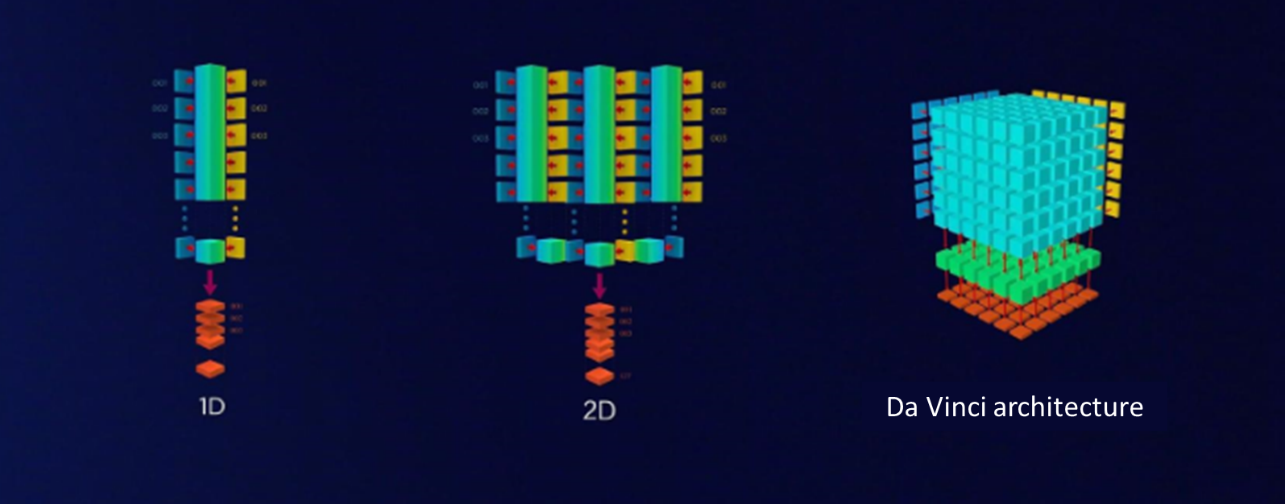
CPUs and DSPs are the first dimension, forming a linear structure that is extremely power-intensive and inefficientwith regard to AI computing. When GPUs and TPUs are added to the system, it's like stacking another dimension on top; then previously understood limitations cease to be relevant, and processing speed is significantly ramped up.Thus, with its 3D structure,the Da Vinci architecture is ideal for complicated matrix calculations required for many AI applications, spurring lightning mobile computing with minimal power consumption. Think of it like traveling through the earth's core (assuming you can safely withstand the insanely high temperature there) to reach your destination on the other end of the world, while other travelers have towalk along the earth's surface.
That's why Da Vinci is fast,as well as being incredibly smart. The Kirin 810 scored over 32,000 in AI-Benchmark tests, easily outperforming its competitors, with the runner-up Snapdragon 855 scoringmore than 3,000 points lower.
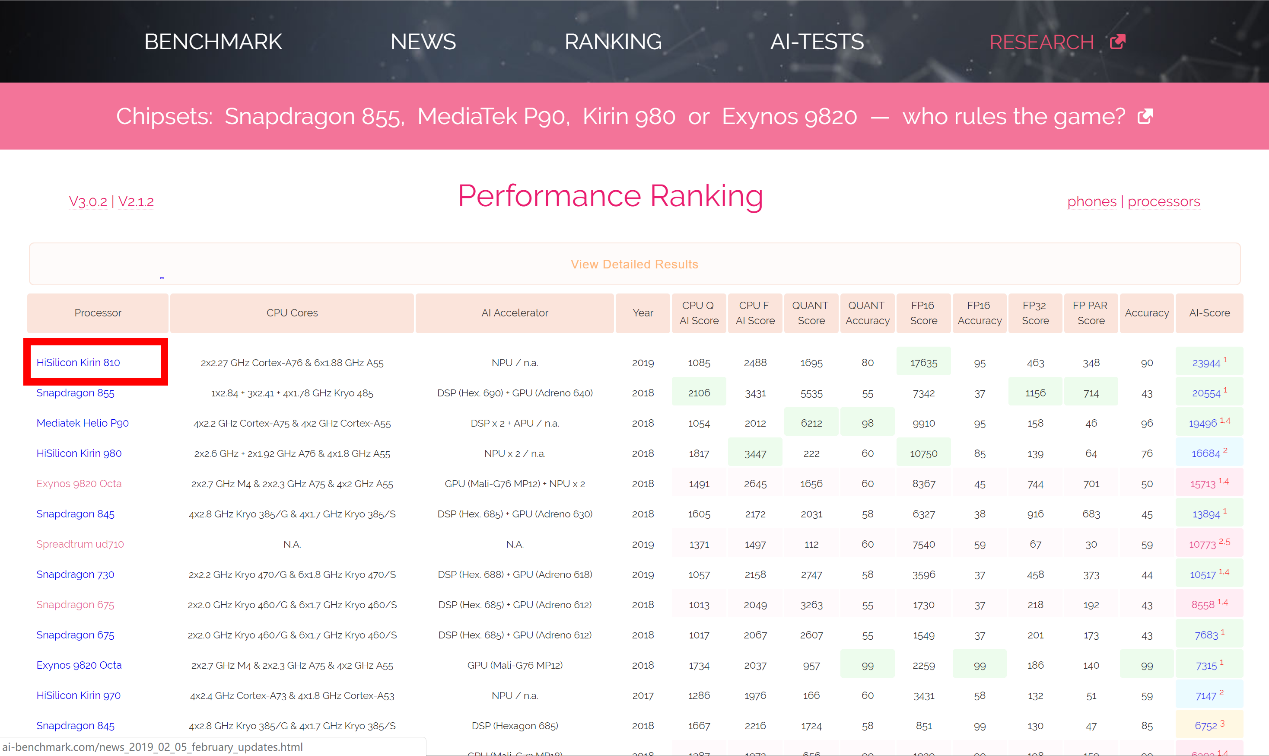
The SoC can support 240+ operators, and possesses industry-leading accuracy for FP16 (16-bit floating point) and INT8 quantification. With all these properties, the NPU is capable of fully leveraging the computing potential on a phone, and endowing itself with soaring intelligence.
As if that weren't enough, the Da Vinci architecture can potentially be applied on a wider range of devices, in contrast to X86 (only supported on computers) and ARM (on the mobile end), as desktop and mobile versions traditionally could not be built on the same structure. Da Vinci changes this status quo, as it canadapted for smart devices of varying sizes, computing power and intelligence levels. This breakthrough is particularly significant for some of the fields that will play an outsized role in shaping modern life—smart city construction, unmanned driving andthe Internet of Everything—capabilities that fully unleash the potential of unbounded intelligence.


- Posts
- Following
- Followers
- Energy
-

 PeaceHunter
Community Team
PeaceHunter
Community Team
-
+ Follow

-
- 494 Posts
- 180 Following
- 2965 Followers
- 108748 Energy


SUBSCRIPTION
I agree to receive the latest offers and information on HONOR products through email or IM (e.g. WhatsApp) provided below and advertisement on third-party platforms. I understand that I can unsubscribe anytime according to Chapter 5 of HONOR Platform Privacy Statement.
CONTACT

- Posts
- photo
- video

Honor 9X blows away the competition at the AI-Benchmark tests — utilizing the Da Vinci architecture to redefine what's possible
Honor's brand-new budget smartphone 9X series was launched with Kirin 810, the brand's proprietaryhigh-end SoC that incorporates the elite 7nm chip process seen on the Kirin 980 and 990, Snapdragon 855 (and rumored on the 865), and Apple's A12 and A13, but at a much more competitive price. Notably, the Kirin 810 adopts yet another in-house development in its NPU design — the so-called "Da Vinci architecture" — which provides for even more impressive AI capabilities that gets it ahead in the performance race than the most renowned names in the industry!
Artificial intelligence will assuredly play an important role in the future, linking people with the intelligent devices around them,as well as the devices themselves with one another. Huawei/Honor has long explored AI's applicationson terminal devices. This led to the use of an AI-supported Neural-network Processing Unit on the Kirin 970 chipset,resulting in accelerated mobile processing and enhanced power efficiency. The next-gen Kirin 980 comes equipped with two NPUs,making waves with its fun, practical and astonishing features such as AI calorie counting, AI color (which renders the subject in color,against a black-and-white background), and AI image translation. The Kirin 810 has turned conventionalwisdom on its head once again, not only with its remarkable AI performance, but also for its status as an 8 series product (compared with the 9 series chipsets like the 980 and 990), which means premium qualityat a cutthroatprice and accessibility to a broader range of consumers.
The Kirin 810's "Da Vinci architecture" — the origin of the name escapes me — is actually a cubic,tensorized, 3D structure that allows for a significantly larger silicon wafer,thereby enhancing productivity and efficiency. It's best conceptualized as a higher-dimension being.
CPUs and DSPs are the first dimension, forming a linear structure that is extremely power-intensive and inefficientwith regard to AI computing. When GPUs and TPUs are added to the system, it's like stacking another dimension on top; then previously understood limitations cease to be relevant, and processing speed is significantly ramped up.Thus, with its 3D structure,the Da Vinci architecture is ideal for complicated matrix calculations required for many AI applications, spurring lightning mobile computing with minimal power consumption. Think of it like traveling through the earth's core (assuming you can safely withstand the insanely high temperature there) to reach your destination on the other end of the world, while other travelers have towalk along the earth's surface.
That's why Da Vinci is fast,as well as being incredibly smart. The Kirin 810 scored over 32,000 in AI-Benchmark tests, easily outperforming its competitors, with the runner-up Snapdragon 855 scoringmore than 3,000 points lower.
The SoC can support 240+ operators, and possesses industry-leading accuracy for FP16 (16-bit floating point) and INT8 quantification. With all these properties, the NPU is capable of fully leveraging the computing potential on a phone, and endowing itself with soaring intelligence.
As if that weren't enough, the Da Vinci architecture can potentially be applied on a wider range of devices, in contrast to X86 (only supported on computers) and ARM (on the mobile end), as desktop and mobile versions traditionally could not be built on the same structure. Da Vinci changes this status quo, as it canadapted for smart devices of varying sizes, computing power and intelligence levels. This breakthrough is particularly significant for some of the fields that will play an outsized role in shaping modern life—smart city construction, unmanned driving andthe Internet of Everything—capabilities that fully unleash the potential of unbounded intelligence.