

 More Products
 Compare









我的荣耀 开启荣耀之旅



 Disagree Terms
 Log out




HONOR 20 Series: Decoding HONOR’s Self-Developed Enhanced Bluetooth


 Last reply :
Ultimate Bluetooth Connectivity 200 Meters Apart
Bluetooth should be a familiar term to most, since it is indispensable in tasks such as transferring files, connecting to wireless speakers and headphones or becoming a standard function for smartphones.
Many users enjoy Bluetooth when connecting to devices that are close-by. However, when the devices are further apart, especially when there are obstructions in the environment, the connection becomes unstable or may even experience cut-offs.
In response to this problem, the recently-launched HONOR 20 introduced an all-new enhanced Bluetooth technology. With the self-developed Hi1103 wireless chipset, the handset can intelligently identify environmental factors and the strength of the Bluetooth signal, thus automatically adjusting the response of the smartphone. At its optimal performance, the HONOR 20 can achieve a steady connection with devices that are 200 meters apart. Enhanced Bluetooth is also far better than ordinary Bluetooth in cases of wall or architectural obstructions. Let us deep-dive into HONOR’s brand-new technology.
High-Speed Bluetooth Mode
Pauses in Bluetooth connection can be easily explained. Take Bluetooth headphones for an example, the connection will become unsteady when the transmission power of either the smartphone or headphone is inadequate, or when the signal receptivity is not strong enough. Imagine two people speaking to each other, if one person is not loud enough or if the other person is hard of hearing, the message would not be transferred.
There are hundreds and thousands of Bluetooth handsets on the market with different capabilities, it is not realistic to push all of their ability to send and receive. At present, the only solution is to start from smartphones and improve their ability to send and receive, which was also the original idea of our enhanced Bluetooth.
Firstly, HONOR introduced the brand-new high-speed Bluetooth mode which tackles the transmission process of Bluetooth signals. Transmission power is doubled, so even if the receiver (Bluetooth headphone) is not sensitive, signals will still be sent steadily as the sender’s (smartphone) voice has been heightened.
In fact, increasing the transmitting power of Bluetooth is a rather simple technology. Another obstacle, however, would be power consumption. Bluetooth itself is not power consuming, but if the high-speed mode is switched on all the time, the battery would be drained at a quicker rate. This is also why high-speed Bluetooth has not been implemented on a larger scale.
AI Intelligent Scenario Detection
The HONOR R&D team invested a huge amount of research and testing to achieve AI detection of different scenarios. The high-speed mode will only be switched on when truly required by users, and switched off intelligently in other scenarios to strike a perfect balance between performance and power loss. The AI detection process involves a lot of standard analysis, explained below with a simple illustration of retransmission rate and Wi-Fi strength.
For retransmission rate, it was mentioned that headphones will reply to confirm that it has received signals from the smartphone, similar to proving that “I have received this part of the music, please play the next section”. When the smartphone does not receive a reply, its Bluetooth often sends the same signal again to try to connect, which is known as retransmission. HONOR 20 can intelligently detect the frequency of retransmissions; when retransmission rate reaches a certain extent, the high-speed mode is activated in an attempt to connect.
Wi-Fi strength is another important indicator. You may wonder how Wi-Fi affects Bluetooth as they are two different functions. In fact, there are a lot of overlap in aspects such as antenna and radio frequency usage. Hence, users downloading an important document with the high-speed Bluetooth mode on may affect its Wi-Fi processing. To tackle this situation, HONOR 20 has designed a detection mechanism through copious consumer behavior analysis. It intelligently identifies usage of Wi-Fi and Bluetooth to balance out between the two.
The two indicators only form a small part of HONOR’s unique AI detection process. HONOR 20 analyses a compiled database to decide whether it activates the high-speed Bluetooth mode.
Apart from signal transmission, HONOR 20 also uses the world-leading HiSilicon Bluetooth chip and optimal antenna design for Bluetooth receptivity, usage is not affected even when it is met with headphones with lower transmission power.
Ultimate Performance Coupled with Safety
The transmission power of Bluetooth itself is low, so even with the high-speed mode activated, its strength is far below other communication tools in our daily lives such as Wi-Fi. Relevant indicators of the HONOR 20 enhanced Bluetooth strictly comply with the international standard of electromagnetic wave SAR, there is no need to worry about any human health concerns.
Let us look at actual statistics. Under normal conditions, Bluetooth audio transmission should look like this:
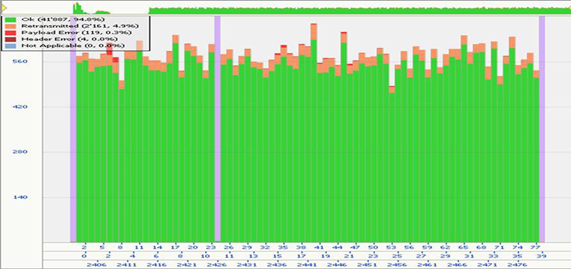
The blue in the picture indicates successful transmission rates, while the light red and red indicates areas in which transmission were problematic.
When the distance between Bluetooth headphones and smartphone increases, or when there are obstacles in-between, the data will look like this:
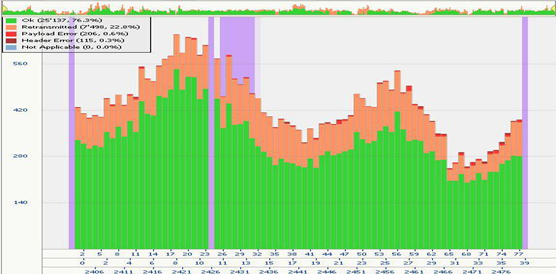
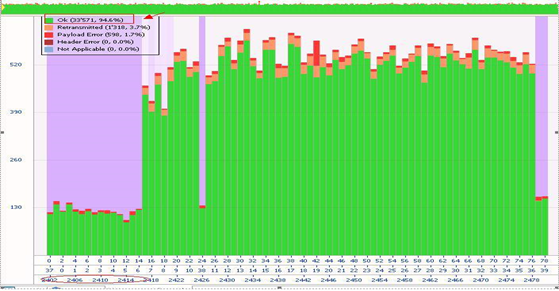
You can see that the red has significantly increased while the green area has obviously decreased, meaning that more transmission failures have been identified. Naturally, users’ connection with the Bluetooth headphones may be poor or even cut-off under such conditions.
However, when the high-speed Bluetooth mode is on, audio transmission gradually returns to its peak despite remote transmission and obstructions.
In another extreme test, HONOR 20 showed significant advantages over other smartphones with high-speed Bluetooth. When tested with the same BeastX Bluetooth headphone to play music, HONOR 20 achieved a steady connection with devices up to a distance of 244 meters, while results for iPhone Xs Max and Galaxy S10+ were 121 meters and 152 meters respectively.


- Posts
- Following
- Followers
- Energy
-

 PeaceHunter
Community Team
PeaceHunter
Community Team
-
+ Follow

-
- 494 Posts
- 180 Following
- 2959 Followers
- 108744 Energy


SUBSCRIPTION
I agree to receive the latest offers and information on HONOR products through email or IM (e.g. WhatsApp) provided below and advertisement on third-party platforms. I understand that I can unsubscribe anytime according to Chapter 5 of HONOR Platform Privacy Statement.
CONTACT

- Posts
- photo
- video

Ultimate Bluetooth Connectivity 200 Meters Apart
Bluetooth should be a familiar term to most, since it is indispensable in tasks such as transferring files, connecting to wireless speakers and headphones or becoming a standard function for smartphones.
Many users enjoy Bluetooth when connecting to devices that are close-by. However, when the devices are further apart, especially when there are obstructions in the environment, the connection becomes unstable or may even experience cut-offs.
In response to this problem, the recently-launched HONOR 20 introduced an all-new enhanced Bluetooth technology. With the self-developed Hi1103 wireless chipset, the handset can intelligently identify environmental factors and the strength of the Bluetooth signal, thus automatically adjusting the response of the smartphone. At its optimal performance, the HONOR 20 can achieve a steady connection with devices that are 200 meters apart. Enhanced Bluetooth is also far better than ordinary Bluetooth in cases of wall or architectural obstructions. Let us deep-dive into HONOR’s brand-new technology.
High-Speed Bluetooth Mode
Pauses in Bluetooth connection can be easily explained. Take Bluetooth headphones for an example, the connection will become unsteady when the transmission power of either the smartphone or headphone is inadequate, or when the signal receptivity is not strong enough. Imagine two people speaking to each other, if one person is not loud enough or if the other person is hard of hearing, the message would not be transferred.
There are hundreds and thousands of Bluetooth handsets on the market with different capabilities, it is not realistic to push all of their ability to send and receive. At present, the only solution is to start from smartphones and improve their ability to send and receive, which was also the original idea of our enhanced Bluetooth.
Firstly, HONOR introduced the brand-new high-speed Bluetooth mode which tackles the transmission process of Bluetooth signals. Transmission power is doubled, so even if the receiver (Bluetooth headphone) is not sensitive, signals will still be sent steadily as the sender’s (smartphone) voice has been heightened.
In fact, increasing the transmitting power of Bluetooth is a rather simple technology. Another obstacle, however, would be power consumption. Bluetooth itself is not power consuming, but if the high-speed mode is switched on all the time, the battery would be drained at a quicker rate. This is also why high-speed Bluetooth has not been implemented on a larger scale.
AI Intelligent Scenario Detection
The HONOR R&D team invested a huge amount of research and testing to achieve AI detection of different scenarios. The high-speed mode will only be switched on when truly required by users, and switched off intelligently in other scenarios to strike a perfect balance between performance and power loss. The AI detection process involves a lot of standard analysis, explained below with a simple illustration of retransmission rate and Wi-Fi strength.
For retransmission rate, it was mentioned that headphones will reply to confirm that it has received signals from the smartphone, similar to proving that “I have received this part of the music, please play the next section”. When the smartphone does not receive a reply, its Bluetooth often sends the same signal again to try to connect, which is known as retransmission. HONOR 20 can intelligently detect the frequency of retransmissions; when retransmission rate reaches a certain extent, the high-speed mode is activated in an attempt to connect.
Wi-Fi strength is another important indicator. You may wonder how Wi-Fi affects Bluetooth as they are two different functions. In fact, there are a lot of overlap in aspects such as antenna and radio frequency usage. Hence, users downloading an important document with the high-speed Bluetooth mode on may affect its Wi-Fi processing. To tackle this situation, HONOR 20 has designed a detection mechanism through copious consumer behavior analysis. It intelligently identifies usage of Wi-Fi and Bluetooth to balance out between the two.
The two indicators only form a small part of HONOR’s unique AI detection process. HONOR 20 analyses a compiled database to decide whether it activates the high-speed Bluetooth mode.
Apart from signal transmission, HONOR 20 also uses the world-leading HiSilicon Bluetooth chip and optimal antenna design for Bluetooth receptivity, usage is not affected even when it is met with headphones with lower transmission power.
Ultimate Performance Coupled with Safety
The transmission power of Bluetooth itself is low, so even with the high-speed mode activated, its strength is far below other communication tools in our daily lives such as Wi-Fi. Relevant indicators of the HONOR 20 enhanced Bluetooth strictly comply with the international standard of electromagnetic wave SAR, there is no need to worry about any human health concerns.
Let us look at actual statistics. Under normal conditions, Bluetooth audio transmission should look like this:
The blue in the picture indicates successful transmission rates, while the light red and red indicates areas in which transmission were problematic.
When the distance between Bluetooth headphones and smartphone increases, or when there are obstacles in-between, the data will look like this:
You can see that the red has significantly increased while the green area has obviously decreased, meaning that more transmission failures have been identified. Naturally, users’ connection with the Bluetooth headphones may be poor or even cut-off under such conditions.
However, when the high-speed Bluetooth mode is on, audio transmission gradually returns to its peak despite remote transmission and obstructions.
In another extreme test, HONOR 20 showed significant advantages over other smartphones with high-speed Bluetooth. When tested with the same BeastX Bluetooth headphone to play music, HONOR 20 achieved a steady connection with devices up to a distance of 244 meters, while results for iPhone Xs Max and Galaxy S10+ were 121 meters and 152 meters respectively.