

 More Products
 Compare












我的荣耀 开启荣耀之旅



 Disagree Terms
 Log out




HONOR 20 PRO's 48MP Quad-Camera: Smartphone Photography for the Ordinary and Extraordinary in Life


 Last reply :
Smartphones have broken one photography barrier after another, coming into common usage as the most convenient method for reproducing daily life. Until recently, smartphone cameras were regarded as vastly inferior to dedicated, professional cameras — fun tools to play around with, but without artistic value for serious photographers. However, this perception has changed dramatically in recent months, with the arrival of sophisticated new models.
Many dedicated photographers take pride in their diverse equipment: wide-angle, standard, fisheye, and telephoto lenses… each ideal for certain scenes and conditions. However, though the weight and cost of all the lenses and equipment can be calculated, no price can put on the missed opportunities for spontaneous visual brilliance. Life passes by too quickly to switch lenses. The scene you just observed may already have disappeared!
HONOR 20 PRO is dedicated to bringing state-of-the-art, all-in-one photography into the mainstream, accessible to anyone at any time. Its quad-camera system is in a class of its own, incorporating a staggering 48MP primary lens, a 117° ultra-wide-angle lens, and a 8MP telephoto lens capable of 3x lossless optical zoom and 30X digital zoom. These lenses account for basically any conceivable shooting scenario, providing powerful SLR-like definition and clarity, as well as the flexibility to go wide (and fit more scenery into breathtaking landscape shots) or up close (to capture clearer details in ravishing food pics). The world’s widest F/1.4 aperture for a smartphone camera, the Ultra-high ISO of 204,800, and "AI + Optical" image stabilization technology interact to capture dazzling nightscapes that our very eyes may be incapable of perceiving.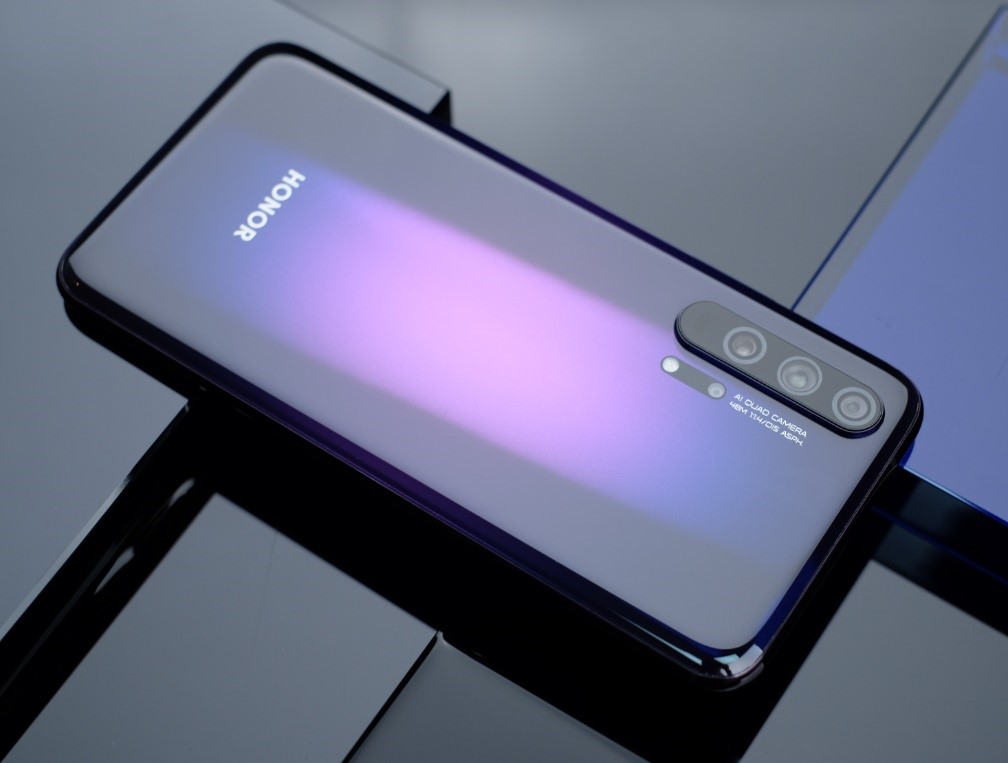
Most flagship phone cameras tend to focus on perfecting specific functions, such as facial beautification, lighting compensation, and image stabilization, but do not attempt to develop an all-inclusive top-tier camera with complementary features working in combination. The HONOR 20 PRO seamlessly integrates four sensors into a professional and versatile mobile camera, with unmatched performance.
DxOMark's comprehensive camera test results give the HONOR 20 PRO a score of 111, which is the 2nd highest score for any smartphone camera.
1. 48MP Lens: Clarity out of the Shadows
The HONOR 20 PRO‘s primary sensor is Sony's 1/2-inch IMX586, with a whopping 48 million effective pixel count to capture images in excellent detail. While this spec is astounding enough on its own, users with a trained eye will find that the 48 megapixels on the product appear to outperform the 48 million pixels on other phones. This is because the 48MP camera works in tandem with the cutting-edge Kirin 980 chipset to create a groundbreaking photography mode: 48MP AI Ultra Clarity.
When this mode is enabled, the HONOR 20 PRO takes multiple shots with a single touch of the shutter, and uses the image processing capability of the Kirin 980's dual ISPs to synthesize the best parts from each shot into a final photo. This photo is then exhaustively analyzed by the Kirin chipset's dual NPUs, with an advanced AI algorithm in operation that optimizes color reproduction, minimizes overexposure in excessively bright regions, and restores detail in the shadows. The HONOR designers have named this feature ''Ultra Clarity'', because remarkably, the final image actually exceeds the capabilities of even a standard 48MP photo.
But why describe the Ultra Clarity effect, when it can simply be shown. It's been said that a picture is worth a thousand words.
2. Dazzling Low-Light Photos Supported by an F/1.4 Aperture and OIS
Night photography has been a stumbling block for professionals and amateur photographers alike. Without a tripod and an expensive camera, all kinds of problems surface, from overexposure, color cast, and lens flare, to blurry photos and prominent noise. The HONOR 20 PRO strives to reproduce SLR-quality imagery in all lighting conditions, and is equipped with the pioneering hardware and software to accomplish this.
World’s Widest F/1.4 Aperture: 50% Higher Light Absorption
Lighting is fundamental to photography, and is influenced by two important components in the camera module: aperture and sensor size. The aperture controls how much light is admitted through the lens, and the sensor size equals the photosensitive surface area, determining how many photons can be captured and processed. Quite simply, the larger the aperture and size of the sensor, the more light a lens can receive, and the better the image resolution and quality will be.
The HONOR 20 PRO features an F/1.4 aperture, the largest ever on a smartphone. It guarantees an average of an additional 50% light reception, when compared with the standard F/1.8 aperture commonly seen on the market. The IMX586 CMOS sensor measures 1/2 inches in size, also offering leading performance.
AI + Optical Image Stabilization: Hand-in-Glove Night Photography
Lengthening the duration of light absorption also enhances lighting. However, as we have all experienced, a long exposure is usually catastrophic without a tripod — even if you think you've been holding the camera as still as humanly possible, the image still comes out blurry. Steady hands aren't sufficient; what's needed instead is superhuman intervention. AIS (AI-assisted Image Stabilization) was developed to help overcome this issue, so that anyone can take professional-quality night photos without the need for a tripod. AIS is based on HDR processing, which means that multiple images are taken with a single shutter press, and the best portions of each image are meticulously assembled to form the final picture. Shorter exposures ensure the right lighting balance in brightly lit areas, while longer exposures restore detail in darker regions.
During the HDR shooting process, specially developed "four-axis OIS (optical image stabilization)" technology uses a gyroscope to identify misalignment within the frame, and counteracts ghosting by moving the lenses in the opposite direction of the motion in the picture. This ensures the series of images to be seamlessly merged into a single photo.
Brilliant nightscapes are now accessible on a smartphone, at the touch of a shutter!
Equivalent 1.6μm Pixel Size and the Inventive Quad Bayer Structure
With the 48MP Sony sensor, some may worry that a higher pixel count would reduce the pixel size, thereby hindering the sensor's light capturing capability or nighttime imaging quality. This is not an issue with the IMX586, which utilizes the Quad Bayer pixel structure and outputs binned 2x2 pixels, increasing the photosensitive surface to that of a 1.6μm pixel. By comparison, most flagship phones on the market feature only 1.2μm pixels.
The no-compromises approach regarding pixel count (detail reproduction) and pixel size (light sensitivity), achieved through cutting-edge hardware and software design on the HONOR 20 PRO, has resulted in the best of both worlds.
3. 16MP Lens: Clarity on a Larger Scale
Ever feel that the camera's perspective is limited? Far-reaching landscapes or impressive skylines that you behold with wonder, can look ordinary within the frame. Panorama shots help somewhat, but stitching can be uneven, and parts of the photo could end up really distorted.
The HONOR 20 PRO's ultra-wide-angle lens resolves this issue once and for all. As the name suggests, the lens provides a wider angle of view, enabling you to fit more within the frame. The contrast between the wide field of view and the immersive depth in the image increases visual tension, creating a spectacular three-dimensional effect. HONOR's optical engineers also took great pains to ensure that distortion is properly calibrated, especially near the edges and corners of the frame, solving a common issue that affects many wide-angle cameras.
In doing so, the HONOR 20 PRO empowers users to recreate scenes in their full complexity, while also capturing stereoscopic subjects with ease.
4. 3X Lossless Zoom through an 8MP Telephoto Lens: Bringing Distant Landscapes into Striking Distance
When wanting to obtain a closer view of far-away subjects, we typically use the zoom feature on a camera. Optical zoom involves actual lens adjustments, and therefore does not degrade image quality. However, due to space limitations, most mobile phone cameras are restricted to a maximum of 2X optical zoom. Digital zoom, which simply crops the existing image and enlarges it to fit the screen, must be activated in its place. You'll typically notice digital zoom when the image quality rapidly decreases, as pixilation and noise increase.
While widening the optical zoom range beyond 2X seems like a fool's errand, given the size limitations in a smartphone, the HONOR 20 PRO engineers tactically utilized a dedicated telephoto lens to raise the limit to 3X. 3X still not good enough? No worries. A multi-frame image synthesis algorithm is employed to retain and reconstruct the details captured by the telephoto lens, ensuring optimal resolution even at 30X digital zoom!
Also worth noting is that the HONOR 20 PRO's telephoto lens also supports four-axis optical image stabilization, effectively reducing blur caused by hand jitters, and providing clear, precise images beyond our wildest expectations.
5. Keeping a Close Eye: Crisp Images from 4cm Away
Close up photography provides us with a fresh look at the world around us. It's a revelation to notice details that exist on too small a scale for the human eye to notice. The possibilities for novelty and creation are limitless.
However, this functionality has proved difficult to recreate in smartphones. The closer one is to the photographed object, the shorter the focal distance, and the further the lens must be from the focal plane. To account for this, lens thickness must be increased to shoot close-up objects, which runs counter to consumer preferences for wafer-thin mobile phones.
Most mobile macro photography solutions only reduce the focal distance to around 7 or 8cm from the object. The HONOR 20 PRO's macro lens gets as close as 4cm to the object. Under the lens, details that are not visible to the naked eye leap off of the screen — intricate patterns on insect wings, dewdrops on flowers — the level of detail is simply stunning!
With its 48MP quad-camera system, the futuristic HONOR 20 PRO brings these timeless moments, and all of those in between, into crystal-clear focus.
Sample images taken by HONOR 20 PRO:


- Posts
- Following
- Followers
- Energy
-

Honorfans35971
-
+ Follow

-
- 2 Posts
- 0 Following
- 0 Followers
- 14 Energy


SUBSCRIPTION
I agree to receive the latest offers and information on HONOR products through email or IM (e.g. WhatsApp) provided below and advertisement on third-party platforms. I understand that I can unsubscribe anytime according to Chapter 5 of HONOR Platform Privacy Statement.
CONTACT

- Posts
- photo
- video

Smartphones have broken one photography barrier after another, coming into common usage as the most convenient method for reproducing daily life. Until recently, smartphone cameras were regarded as vastly inferior to dedicated, professional cameras — fun tools to play around with, but without artistic value for serious photographers. However, this perception has changed dramatically in recent months, with the arrival of sophisticated new models.

 AIS (AI-assisted Image Stabilization) was developed to help overcome this issue, so that anyone can take professional-quality night photos without the need for a tripod. AIS is based on HDR processing, which means that multiple images are taken with a single shutter press, and the best portions of each image are meticulously assembled to form the final picture. Shorter exposures ensure the right lighting balance in brightly lit areas, while longer exposures restore detail in darker regions.
Many dedicated photographers take pride in their diverse equipment: wide-angle, standard, fisheye, and telephoto lenses… each ideal for certain scenes and conditions. However, though the weight and cost of all the lenses and equipment can be calculated, no price can put on the missed opportunities for spontaneous visual brilliance. Life passes by too quickly to switch lenses. The scene you just observed may already have disappeared!
HONOR 20 PRO is dedicated to bringing state-of-the-art, all-in-one photography into the mainstream, accessible to anyone at any time. Its quad-camera system is in a class of its own, incorporating a staggering 48MP primary lens, a 117° ultra-wide-angle lens, and a 8MP telephoto lens capable of 3x lossless optical zoom and 30X digital zoom. These lenses account for basically any conceivable shooting scenario, providing powerful SLR-like definition and clarity, as well as the flexibility to go wide (and fit more scenery into breathtaking landscape shots) or up close (to capture clearer details in ravishing food pics). The world’s widest F/1.4 aperture for a smartphone camera, the Ultra-high ISO of 204,800, and "AI + Optical" image stabilization technology interact to capture dazzling nightscapes that our very eyes may be incapable of perceiving.
Most flagship phone cameras tend to focus on perfecting specific functions, such as facial beautification, lighting compensation, and image stabilization, but do not attempt to develop an all-inclusive top-tier camera with complementary features working in combination. The HONOR 20 PRO seamlessly integrates four sensors into a professional and versatile mobile camera, with unmatched performance.
DxOMark's comprehensive camera test results give the HONOR 20 PRO a score of 111, which is the 2nd highest score for any smartphone camera.
1. 48MP Lens: Clarity out of the Shadows
The HONOR 20 PRO‘s primary sensor is Sony's 1/2-inch IMX586, with a whopping 48 million effective pixel count to capture images in excellent detail. While this spec is astounding enough on its own, users with a trained eye will find that the 48 megapixels on the product appear to outperform the 48 million pixels on other phones. This is because the 48MP camera works in tandem with the cutting-edge Kirin 980 chipset to create a groundbreaking photography mode: 48MP AI Ultra Clarity.
When this mode is enabled, the HONOR 20 PRO takes multiple shots with a single touch of the shutter, and uses the image processing capability of the Kirin 980's dual ISPs to synthesize the best parts from each shot into a final photo. This photo is then exhaustively analyzed by the Kirin chipset's dual NPUs, with an advanced AI algorithm in operation that optimizes color reproduction, minimizes overexposure in excessively bright regions, and restores detail in the shadows. The HONOR designers have named this feature ''Ultra Clarity'', because remarkably, the final image actually exceeds the capabilities of even a standard 48MP photo.
But why describe the Ultra Clarity effect, when it can simply be shown. It's been said that a picture is worth a thousand words.
2. Dazzling Low-Light Photos Supported by an F/1.4 Aperture and OIS
Night photography has been a stumbling block for professionals and amateur photographers alike. Without a tripod and an expensive camera, all kinds of problems surface, from overexposure, color cast, and lens flare, to blurry photos and prominent noise. The HONOR 20 PRO strives to reproduce SLR-quality imagery in all lighting conditions, and is equipped with the pioneering hardware and software to accomplish this.
World’s Widest F/1.4 Aperture: 50% Higher Light Absorption
Lighting is fundamental to photography, and is influenced by two important components in the camera module: aperture and sensor size. The aperture controls how much light is admitted through the lens, and the sensor size equals the photosensitive surface area, determining how many photons can be captured and processed. Quite simply, the larger the aperture and size of the sensor, the more light a lens can receive, and the better the image resolution and quality will be.
The HONOR 20 PRO features an F/1.4 aperture, the largest ever on a smartphone. It guarantees an average of an additional 50% light reception, when compared with the standard F/1.8 aperture commonly seen on the market. The IMX586 CMOS sensor measures 1/2 inches in size, also offering leading performance.
AI + Optical Image Stabilization: Hand-in-Glove Night Photography
Lengthening the duration of light absorption also enhances lighting. However, as we have all experienced, a long exposure is usually catastrophic without a tripod — even if you think you've been holding the camera as still as humanly possible, the image still comes out blurry. Steady hands aren't sufficient; what's needed instead is superhuman intervention.
During the HDR shooting process, specially developed "four-axis OIS (optical image stabilization)" technology uses a gyroscope to identify misalignment within the frame, and counteracts ghosting by moving the lenses in the opposite direction of the motion in the picture. This ensures the series of images to be seamlessly merged into a single photo.
Brilliant nightscapes are now accessible on a smartphone, at the touch of a shutter!
Equivalent 1.6μm Pixel Size and the Inventive Quad Bayer Structure
With the 48MP Sony sensor, some may worry that a higher pixel count would reduce the pixel size, thereby hindering the sensor's light capturing capability or nighttime imaging quality. This is not an issue with the IMX586, which utilizes the Quad Bayer pixel structure and outputs binned 2x2 pixels, increasing the photosensitive surface to that of a 1.6μm pixel. By comparison, most flagship phones on the market feature only 1.2μm pixels.
The no-compromises approach regarding pixel count (detail reproduction) and pixel size (light sensitivity), achieved through cutting-edge hardware and software design on the HONOR 20 PRO, has resulted in the best of both worlds.
3. 16MP Lens: Clarity on a Larger Scale
Ever feel that the camera's perspective is limited? Far-reaching landscapes or impressive skylines that you behold with wonder, can look ordinary within the frame. Panorama shots help somewhat, but stitching can be uneven, and parts of the photo could end up really distorted.
The HONOR 20 PRO's ultra-wide-angle lens resolves this issue once and for all. As the name suggests, the lens provides a wider angle of view, enabling you to fit more within the frame. The contrast between the wide field of view and the immersive depth in the image increases visual tension, creating a spectacular three-dimensional effect. HONOR's optical engineers also took great pains to ensure that distortion is properly calibrated, especially near the edges and corners of the frame, solving a common issue that affects many wide-angle cameras.
In doing so, the HONOR 20 PRO empowers users to recreate scenes in their full complexity, while also capturing stereoscopic subjects with ease.
4. 3X Lossless Zoom through an 8MP Telephoto Lens: Bringing Distant Landscapes into Striking Distance
When wanting to obtain a closer view of far-away subjects, we typically use the zoom feature on a camera. Optical zoom involves actual lens adjustments, and therefore does not degrade image quality. However, due to space limitations, most mobile phone cameras are restricted to a maximum of 2X optical zoom. Digital zoom, which simply crops the existing image and enlarges it to fit the screen, must be activated in its place. You'll typically notice digital zoom when the image quality rapidly decreases, as pixilation and noise increase.
While widening the optical zoom range beyond 2X seems like a fool's errand, given the size limitations in a smartphone, the HONOR 20 PRO engineers tactically utilized a dedicated telephoto lens to raise the limit to 3X. 3X still not good enough? No worries. A multi-frame image synthesis algorithm is employed to retain and reconstruct the details captured by the telephoto lens, ensuring optimal resolution even at 30X digital zoom!
Also worth noting is that the HONOR 20 PRO's telephoto lens also supports four-axis optical image stabilization, effectively reducing blur caused by hand jitters, and providing clear, precise images beyond our wildest expectations.
5. Keeping a Close Eye: Crisp Images from 4cm Away
Close up photography provides us with a fresh look at the world around us. It's a revelation to notice details that exist on too small a scale for the human eye to notice. The possibilities for novelty and creation are limitless.
However, this functionality has proved difficult to recreate in smartphones. The closer one is to the photographed object, the shorter the focal distance, and the further the lens must be from the focal plane. To account for this, lens thickness must be increased to shoot close-up objects, which runs counter to consumer preferences for wafer-thin mobile phones.
Most mobile macro photography solutions only reduce the focal distance to around 7 or 8cm from the object. The HONOR 20 PRO's macro lens gets as close as 4cm to the object. Under the lens, details that are not visible to the naked eye leap off of the screen — intricate patterns on insect wings, dewdrops on flowers — the level of detail is simply stunning!
With its 48MP quad-camera system, the futuristic HONOR 20 PRO brings these timeless moments, and all of those in between, into crystal-clear focus.
Sample images taken by HONOR 20 PRO: