



 More Products
 Compare












我的荣耀 开启荣耀之旅



 Disagree Terms
 Log out




[Magic Earbuds] Can ANC Technology harm your hearing? ANC Tech Deep-dive!


 Last reply :
Dear HONOR Fans,
Noise-canceling headphones have become a major hit in an era of * content, as they allow users to enjoy crystal-clear, distraction-free audio during noisy commutes or workouts, from relaxing music to engaging podcasts. Hence why we are releasing our HONOR Magic Earbuds! This newfound convenience can have consequences however, as wearing a pair of headphones continuously can be irritating on one's ears. In fact, there's widespread belief that active noise-canceling (ANC) headphones do greater harm to one's hearing when worn for an extended period of time, than passive noise-canceling headphones.
Is this concern justified? The answer requires a deep dive into the technology behind ANC.
In a nutshell, ANC is based on a process called wave phase cancelation. The ANC circuits collect and analyse undesired background noise, create sound waves that are 180 degrees out of phase, and use the inverted signal to counterbalance the noise. An good analogy is the symmetry between negative and positive numbers: –1 + 1 = 0. As a result of this process, background noise has been "evened out" by the time the music from the speaker reaches your ears, almost entirely free of ambient noise.
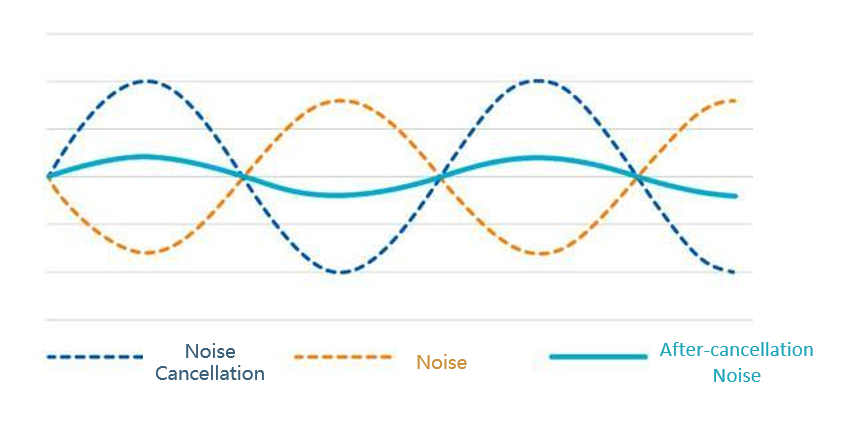
In this way, the technology does "actively" reduce noise, and in an extremely effective manner. Simply by popping in pair of ANC headphones, you avoid the need to increase headphone speaker volume to compensate for a noisy environment, a practice we're all familiar with, but one that can result in long-term hearing damage. Therefore, ANC actually protects your hearing, even after long-term use.
Nevertheless, some ANC headphone users have complained about soreness in their ears, and in some cases, even dizziness or nausea. Can this be attributed to the headphones' noise-cancelation properties?
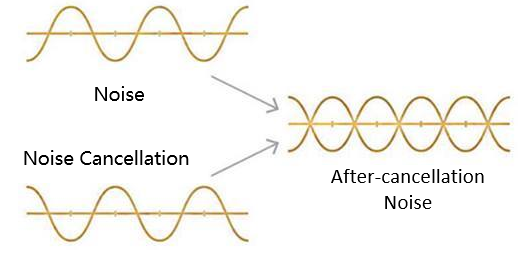
Theoretically speaking, if the headphone-generated sound waves were to precisely negate background noise, with a 180-degree phase difference, noise cancellation would be perfect. In reality, however, the accurate capturing of noise and generation of corresponding cancelation waveforms presents quite a challenge. Although headphone chips and algorithms are meticulously designed, even they can't account for the sheer number of the types of noise out there — this means noise cannot be completely eliminated in practice. The worst case scenario: sound waves that are supposed to cancel each other out end up accumulating to double the volume! Fortunately that's a rare phenomenon. Still, the principle that total cancellation is largely elusive, holds true.
Noise reduction performance can also be affected by product design and user wearing habits. For instance, in-ear headphones generally block ambient noise better than over-ear designs, but apply pressure directly in the ear canal, which can cause discomfort after extended periods of use. In addition, it's difficult to find a good fit. Even if you've managed to find just the right pair that offers a stable fit, placing any object in your ear interferes with airflow, and can lead to an increase in bacteria levels. Over the time, your ear canals may be more susceptible to infection and inflammation, or more serious harm.
Over-ear headphones are well-padded and easy to wear, and provide for greater comfort alongside satisfactory noise control. However, they're bulkier and far less portable. They tend to get quite loud also, more prone to leaking a wider range of frequencies and distract those around you.

ANC headphones tend to do a really good job at noise isolation. But when most of the ambient noise has been filtered out, infrasounds, those below 20 Hz, those beyond the hearing range for humans, become more prominent. Research indicates that infrasound can lead to shortness of breath and chest discomfort, or headache and nausea, but it's also ubiquitous, even in nature, so our bodies are usually equipped to deal with it. Still, some people may be more sensitive to the effects of infrasound than others.
Therefore, taking off your headphones when they're not playing anything, is a good habit that can help mitigate any minor discomfort you may experience.
All that being said, ANC headphones certainly will not harm your hearing, and in the vast majority of cases have no direct effect on your ears. But in our modern world characterized by unwanted distractions and ever-present noise-pollution, they can do wonders… for both your ears, and soundness of mind!
If you'd like to find out more about this topic and ask some more questions about how ANC technology in our new HONOR Magic Earbuds performs, don't forget to join our AMA Livestream and teardown tomorrow and remember the earlier time of 12.30pm!
https://community.hihonor.com/uk/topic/18415/detail.htm
Do you enjoy these deep-dives into the tech behind our new products? Let us know in the comment below!


- Posts
- Following
- Followers
- Energy
-

 Matt HONOR
Community Team
Matt HONOR
Community Team
-
+ Follow

-
- 565 Posts
- 67 Following
- 2488 Followers
- 50508 Energy



- Posts
- photo
- video

Dear HONOR Fans,
Noise-canceling headphones have become a major hit in an era of * content, as they allow users to enjoy crystal-clear, distraction-free audio during noisy commutes or workouts, from relaxing music to engaging podcasts. Hence why we are releasing our HONOR Magic Earbuds! This newfound convenience can have consequences however, as wearing a pair of headphones continuously can be irritating on one's ears. In fact, there's widespread belief that active noise-canceling (ANC) headphones do greater harm to one's hearing when worn for an extended period of time, than passive noise-canceling headphones.
Is this concern justified? The answer requires a deep dive into the technology behind ANC.
In a nutshell, ANC is based on a process called wave phase cancelation. The ANC circuits collect and analyse undesired background noise, create sound waves that are 180 degrees out of phase, and use the inverted signal to counterbalance the noise. An good analogy is the symmetry between negative and positive numbers: –1 + 1 = 0. As a result of this process, background noise has been "evened out" by the time the music from the speaker reaches your ears, almost entirely free of ambient noise.
In this way, the technology does "actively" reduce noise, and in an extremely effective manner. Simply by popping in pair of ANC headphones, you avoid the need to increase headphone speaker volume to compensate for a noisy environment, a practice we're all familiar with, but one that can result in long-term hearing damage. Therefore, ANC actually protects your hearing, even after long-term use.
Nevertheless, some ANC headphone users have complained about soreness in their ears, and in some cases, even dizziness or nausea. Can this be attributed to the headphones' noise-cancelation properties?
Theoretically speaking, if the headphone-generated sound waves were to precisely negate background noise, with a 180-degree phase difference, noise cancellation would be perfect. In reality, however, the accurate capturing of noise and generation of corresponding cancelation waveforms presents quite a challenge. Although headphone chips and algorithms are meticulously designed, even they can't account for the sheer number of the types of noise out there — this means noise cannot be completely eliminated in practice. The worst case scenario: sound waves that are supposed to cancel each other out end up accumulating to double the volume! Fortunately that's a rare phenomenon. Still, the principle that total cancellation is largely elusive, holds true.
Noise reduction performance can also be affected by product design and user wearing habits. For instance, in-ear headphones generally block ambient noise better than over-ear designs, but apply pressure directly in the ear canal, which can cause discomfort after extended periods of use. In addition, it's difficult to find a good fit. Even if you've managed to find just the right pair that offers a stable fit, placing any object in your ear interferes with airflow, and can lead to an increase in bacteria levels. Over the time, your ear canals may be more susceptible to infection and inflammation, or more serious harm.
Over-ear headphones are well-padded and easy to wear, and provide for greater comfort alongside satisfactory noise control. However, they're bulkier and far less portable. They tend to get quite loud also, more prone to leaking a wider range of frequencies and distract those around you.
ANC headphones tend to do a really good job at noise isolation. But when most of the ambient noise has been filtered out, infrasounds, those below 20 Hz, those beyond the hearing range for humans, become more prominent. Research indicates that infrasound can lead to shortness of breath and chest discomfort, or headache and nausea, but it's also ubiquitous, even in nature, so our bodies are usually equipped to deal with it. Still, some people may be more sensitive to the effects of infrasound than others.
Therefore, taking off your headphones when they're not playing anything, is a good habit that can help mitigate any minor discomfort you may experience.
All that being said, ANC headphones certainly will not harm your hearing, and in the vast majority of cases have no direct effect on your ears. But in our modern world characterized by unwanted distractions and ever-present noise-pollution, they can do wonders… for both your ears, and soundness of mind!
If you'd like to find out more about this topic and ask some more questions about how ANC technology in our new HONOR Magic Earbuds performs, don't forget to join our AMA Livestream and teardown tomorrow and remember the earlier time of 12.30pm!
https://community.hihonor.com/uk/topic/18415/detail.htm
Do you enjoy these deep-dives into the tech behind our new products? Let us know in the comment below!